

The Long Tail: Maybe You Don't Have Too Many SKUs. Maybe You're Managing Them the Wrong Way.

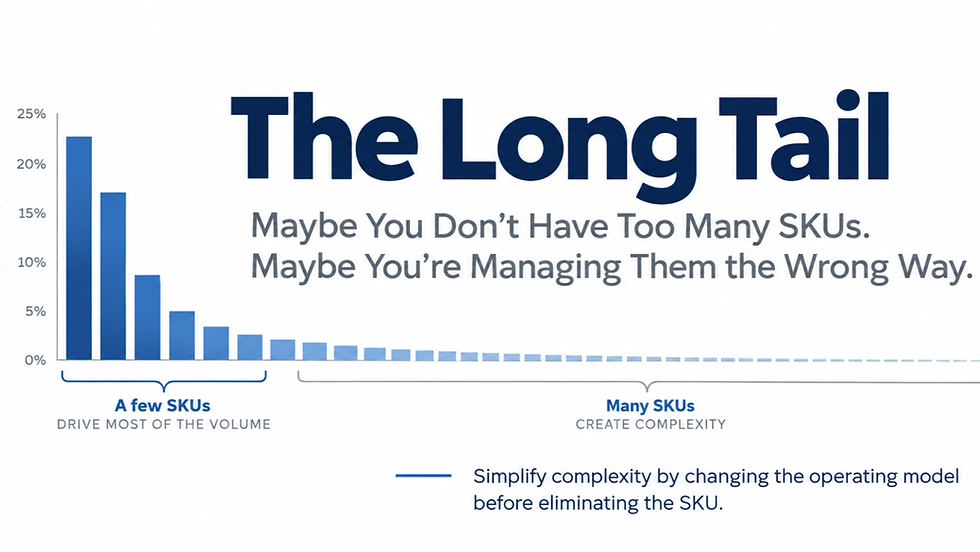
SKU rationalization is often the default response to portfolio complexity. But what if the bigger opportunity is to change how products are planned and fulfilled rather than eliminate them?
Most manufacturers and distributors carry a long tail of products that contribute relatively little revenue individually but collectively create a disproportionate amount of work.
Together, these products tie up working capital, warehouse space, and planning resources. They can drive small production runs, frequent changeovers, excess inventory, and eventually obsolescence.
At some point, someone asks:
"Why are we still carrying all these SKUs?"
The usual response is to launch a rationalization initiative: identify low-volume products, calculate their contribution, and begin eliminating them. Sometimes that is exactly the right answer.
But a low-volume SKU is not necessarily a low-value SKU. Often the bigger problem is that companies manage fundamentally different products with essentially the same planning and fulfillment rules.
Not Every SKU Deserves the Same Operating Model
At IBP2, we often begin by segmenting demand. A nine-cell ABC-XYZ analysis compares a product’s contribution (revenue, gross margin, or volume) with its demand variability, often measured by the coefficient of variation at the SKU level. We then group the nine cells into four operating segments: S1 Predictable Drivers, S2 Stable Contributors, S3 Critical Collaborators, and S4 Defensive Distractors.
The point is not to create an automatic delisting matrix. The S4 segment, in particular, is a prompt for deeper analysis, not a verdict on which products should disappear.
More predictable demand | More variable demand | |
Higher contribution | S1 Predictable Drivers | S3 Critical Collaborators |
Lower contribution | S2 Stable Contributors | S4 Defensive Distractors |
Illustrative four-segment operating view of the ABC-XYZ analysis. The original nine-cell detail still informs the policy decisions.
Consider three products:
· A replacement part sells only a few times a year but is essential to supporting equipment purchased by an important customer.
· A specialty product generates relatively few orders, but customers are willing to accept a three-week lead time.
· A seasonal item sells most of its volume during a ten-week period and must be immediately available throughout that window.
All three may be flagged for review in a long-tail analysis. Yet their customer value, demand characteristics, and service requirements are different. Eliminating them could do more harm than good.
A more useful question is:
"How can we continue serving demand for this SKU at the lowest sustainable cost without compromising the customer promise?"
Go Deeper Before Choosing a Policy
For products identified in the long tail, especially the S4 segment, we recommend looking through four connected lenses:
· Contribution. How much revenue, gross margin, and economic value does the product generate?
· Cost-to-serve. What does it really cost to manufacture, source, inventory, plan, and deliver the item?
· Demand characteristics. Is demand predictable, volatile, intermittent, or seasonal? At what level can it be forecast reliably?
· Strategic value. Does the product support a critical customer, a service obligation, a broader product sale, or market positioning?
These distinctions matter because two products with identical annual revenue can have very different operating economics. One may sell consistently each week; another may sell twice a year in large batches. They should not automatically receive the same forecasting, replenishment, and inventory policies.
The level at which we forecast demand also need not match the level at which we stock or fulfill it. Forecasting a product family may yield a more reliable signal than forecasting every variant separately. Companies can then hold common components and configure the final product after an order arrives.
A better forecast sometimes comes from the right level of aggregation—not a more sophisticated algorithm.
Rationalization Is Only One of Several Possible Responses
With a clearer view of demand, economics, and customer value, companies can choose among several operating policies:
Operating policy | How the operating model changes |
1. Selective make-to-stock | Stock finished goods only where the customer service promise requires them. |
2. Simplified min/max | Use low-touch reorder parameters for slow but recurring demand rather than continually revising a forecast. |
3. Make-to-order/assemble-to-order | Produce or configure on order when lead times allow; hold common components where practical. |
4. Seasonal availability | Define selling windows and align production and inventory with seasonal demand. |
5. Supplier-direct fulfillment | Use qualified suppliers to hold inventory and ship directly, subject to service commitments. |
6. Product consolidation | Migrate demand to approved common products or interchangeable alternatives. |
7. Pricing/MOQs/terms | Align prices, order minimums, and service terms with the cost of serving niche demand. |
8. Rationalization / discontinuation | Exit when customer value and economics cannot justify a feasible operating model. |
These are not eight steps toward eliminating a SKU – they are eight different ways of managing it. As demand declines, a product might move from make-to-stock to make-to-order or supplier-direct fulfillment, preserving a contribution that would otherwise disappear.
The Hidden Economics of Product Complexity
Portfolio reviews often rely too heavily on gross margin. But a slow-moving, high-margin SKU may require unique components, small batches, frequent changeovers, dedicated inventory across several distribution centers, and costly expedites. Its margin can look attractive while the product consumes scarce resources elsewhere in the supply chain.
There is a trap in the other direction as well: allocated fixed overhead does not automatically disappear when a product is eliminated. A credible business case distinguishes costs that are actually avoidable from accounting allocations and identifies which resources can be redeployed.
That matters especially when manufacturing or distribution capacity is constrained. Fewer unnecessary setups, less inventory fragmentation, and simpler fulfillment routes can release capacity for products with stronger demand and better contribution. When the capacity freed is at a genuine bottleneck, it can also help defer additional capital investment.
The benefit can be much larger than an inventory reduction.
The Policy Must Match the Customer Promise
Changing a planning parameter without changing the operating model accomplishes little.
Suppose a slow-moving product moves from make-to-stock to make-to-order. Operations agrees; Planning removes the finished goods inventory target; Finance anticipates an improvement in working capital. But Sales continues promising delivery within 48 hours.
The company has not solved the problem. It has created a future service failure.
Every differentiated SKU policy requires four coordinated decisions: How will we plan demand? What inventory will we hold? How will we fulfill orders? And what will we promise customers?
These decisions must be reflected in planning parameters, ERP master data, sourcing arrangements, commercial commitments, and exception management. SKU policy is a cross-functional business decision, not simply an inventory planning exercise.
Make End-of-Life Management a Discipline, Not an Event
Too many organizations treat SKU rationalization as a cleanup exercise. Inventory accumulates, complexity becomes painful, and a one-time project begins. By then, opportunities to migrate customers, adjust fulfillment models, or reduce exposure may already have been missed.
End-of-life (EOL) management should instead be a recurring part of product lifecycle management and S&OP/IBP. A regular review cadence, with clearly defined triggers and exceptions, enables teams to reassess contribution, cost-to-serve, demand behavior, customer obligations, and fulfillment options before products become operational burdens.
This discipline extends across the lifecycle. New products enter with an initial operating policy and a review date. Mature products are reclassified as demand changes. Declining products receive explicit transition plans: a different replenishment method, an alternative fulfillment route, customer migration, or, when warranted, discontinuation.
Each decision needs a named owner across Commercial, Finance, Planning, Operations, and Sourcing. A consistent scorecard, agreed decision rights, updated system parameters, and customer communication turn analysis into action.
Success should not be measured only by the number of SKUs eliminated. Better measures include contribution, inventory and obsolescence exposure, manufacturing setups, planning workload, expediting costs, capacity utilization, and service performance.
The Real Payoff: Focus, Simplicity, and Capacity for Growth
A disciplined approach to the long tail does more than tidy up the product catalog. It changes where the company spends its scarce resources.
When planners spend less time repeatedly forecasting intermittent items or managing avoidable exceptions, they can focus on the products and decisions that drive profitability. When operations reduces unnecessary setups, inventory positions, and handling steps, the supply chain becomes simpler and more responsive. And when that work releases constrained manufacturing or distribution capacity, it may delay major capital outlays that would otherwise be required to accommodate complexity rather than genuine growth.
At IBP2, this is what we mean when we say we “simplify complexity”: preserve the products and customer choices that create value while removing unnecessary planning effort, inventory, and operational burden. These benefits do not come from a single SKU purge. They compound when end-of-life reviews become a regular management discipline and operating policies evolve as products move through their lifecycle.
Before asking, "How many SKUs can we eliminate?" ask instead: "Are we using the right planning and fulfillment model for each product—and reviewing that choice often enough?"
The goal is not the smallest portfolio. It is a portfolio that consistently directs capital, capacity, and management attention to the products that create the most value.
What has created more value in your organization: eliminating long-tail SKUs, or changing how they are planned and fulfilled?


Comments